Thursday, September 12, 2013

Five Film Favorites: Movies About Television

by F.T. Rea

In the early-1950s television’s ability to reach into America’s living rooms was taking the country by storm. The advertising industry that was building up around television was already overshadowing the nation’s culture. Many observers saw TV as being in the process of killing off the Hollywood movie-making industry and the movie-exhibiting business, coast-to-coast.

To lure audiences into aging downtown movie palaces the most panicked producers in Hollywood reached out to eye candy developments such as CinemaScope and 3-D. Soon the studios decided they had to stop making movies in black and white. Eventually, one by one, the major studios sold off the rights to their old features to television. Into the '60s, the businessmen of Hollywood realized they had to throw off the Hays Code, adopted in the early-’30s to keep what was then as "smut" out of American movies.

A national trend moved the movie theater business into new multiplexes in the suburbs. Downtown single-auditorium movie houses fell onto hard times. So, Richmond is fortunate to have an authentic old movie palace still in operation as a cinema: The Byrd Theatre, which opened in 1928, is now owned and operated by a non-profit foundation.

Yet, some 60 years after the doom of big-budget movie-making was being predicted, while the old studio system that thrived in the ‘30s and ‘40s is history, it seems no matter how much it costs to make feature films, determined producers will always figure out ways to keep doing it.

Of course, one of the things that Hollywood has relished doing what television couldn’t do, or wouldn’t do, for a long time, was to tell unflattering stories about how the people who rule the television industry operate. As a medium, TV was too uptight to pull back the curtain to reveal its inner works. In other words, "The Dick Van Dyke Show" wasn’t a realistic look at the job of producing a weekly sitcom.

However circuitous, that introduction leads us to this installment of five film favorites -- movies about television. All of them were made in the 20th century, one of them, just barely: 

  • “Broadcast News” (1987): Color. 133 minutes. Directed by  James L. Brooks. Cast: William Hurt, Albert Brooks, Holly Hunter, Jack Nicholson. Note: The inevitable rivalries that color the relationships of the news producer, writer/reporter and presenter/anchorman are explored. Being overly self-absorbed is an industry requirement. Roger Ebert said: “[As] knowledgeable about the TV news-gathering process as any movie ever made.”
  • “The China Syndrome” (1979): Color. 122 minutes. Directed by James Bridges. Cast: Jane Fonda, Jack Lemmon, Michael Douglas, Scott Brady. Note: A reporter discovers a cover-up of an accident at a nuclear power plant and all hell breaks loose. Her determination to tell the story becomes dangerous to her and anyone close by. Ironically, the infamous Three Mile Island partial meltdown incident in Pennsylvania happened 12 days after this film was released in 1979. 
  • “A Face in the Crowd” (1957): B&W. 126 minutes. Directed by Elia Kazan. Cast: Andy Griffith, Patricia Neal, Walter Matthau, Anthony Franciosa, Lee Remick. Note: An early warning about television’s potential to boost a charismatic personality into real power. As corny as this film is, in ways, most of it holds up well. Although Andy Griffith doesn’t play a heavy often, he sure knocks it out of the park in this one.
  • “Magnolia” (1999): Color. 188 minutes. Directed by  Paul Thomas Anderson. Cast: Jason Robards, Julianne Moore, John C. Reilly, Philip Seymour Hoffman, William H. Macy, Tom Cruise, Philip Baker Hall. Note: A dark but whimsical story about fate and luck, told from several angles that overlap. The scene that unites all the characters, to sing the same Aimee Mann song is about as risky AND as satisfying as it gets on the big screen.
  • “Network” (1976): Color. 121 minutes. Directed by Sydney Lumet. Cast: Peter Finch, Faye Dunaway, William Holden, Robert Duvall. Note: The future of cable television’s soon-to-be-seen excesses in bad taste is anticipated with chilling accuracy by writer Paddy Chayefsky. Finch’s unhinged anchorman character, Howard “I’m Mad as Hell” Beale, is unforgettable. It won him an Oscar.
Close runners-up: Although I wanted to put “Medium Cool” (1969) on this list, it’s been so long since I’ve seen it that I couldn‘t do it. “Wag the Dog” (1997) almost made the list, too. If I’ve left off your favorite movie about television, please feel free to use the comments option this blogzine offers to give it its proper due.

Next Thursday another Five Film Favorites episode with a different category will be offered. 

Friday, September 6, 2013

Short Subject: 'Sentinels of Silence'


Ed. Note: “Sentinels of Silence” (1971): Color. 18 minutes. Directed by Robert Amram. Narrated by Orson Welles. Note: Offering breathtaking aerial views of the ruins of ancient Mexican civilizations, this is the only short film to win Academy Awards in two categories in the same year. After "Sentinels of Silence" grabbed two Oscars in 1972 the rules were changed to prevent the same thing from happening again. 

In the way of local trivia, on May 22, 1972, a little over a month after its dual-Oscar-win, this stunningly beautiful short film had its Richmond premiere at the Biograph Theatre. 


Thursday, September 5, 2013

Five Film Favorites: War Movies

by F.T. Rea 

Yes, like it or not, the drumbeat for war is sounding again and stirring passions. The debate inside the beltway over whether to bomb Syria is taking place as these words are being written. Justifications, warnings and predictions are in the air. With uncertainty swirling about, one thing is for sure -- filmmakers are paying attention to what’s happening. They are taking notes for the movies to be made about what’s happening … and what will follow.

As a setting for compelling stories the extremes of war have been useful to filmmakers throughout the history of movies. The first American feature-length motion picture to receive widespread distribution was D.W. Griffith’s rather warped melodrama about the American Civil War and its aftermath, “The Birth of a Nation” (1915).

Depending on what might be called a “war movie,” at least 20 such feature films have won the Academy Award for Best Picture. The problem with arriving at an exact number is that while some movies are set during wars, not all of them seem like traditional “war movies.” Which opens the door to the problem of defining that term.

Well, for today’s purpose “war movies” are going to be divided into two categories: heroic and anti-war. Still, most of the best war movies, at least in my book, have at least a hint of anti-war sentiment in them. Some might call it sanity. After all, war isn’t just hell, it’s crazy hell.

For this week’s list of favorites a “heroic war film” is about the quest to bravely fight through that crazy hell as part of a larger purpose. Such films are usually about losing oneself in the pursuit of that quest. Whereas, an “anti-war film” is more about the toll of war, or the sheer folly of it.

Thus, I have to cheat for this week’s favorites list -- two different sets of five favorites are needed to cover the war front.

Heroic War Films
  • “Attack” (1956): B&W. 107 minutes. Directed by Robert Aldrich. Cast: Jack Palance, Eddie Albert, Lee Marvin. Note: This gritty WWII yarn pits extremes against one another with cynicism as the referee. Cooney is the hated officer who owes his rank to political pull. Caught in the throes of a fit of cowardice he fails to support his men when it counts most. One of them, Costa, survives and wants Cooney to pay.
  • “The Deer Hunter” (1978): Color. 182 minutes. Directed by Michael Cimino. Cast: Robert De Niro, Christopher Walken, Meryl Streep, John Savage, John Cazale. Note: This tense story pulls three pals loose from their familiar blue collar moorings. It drops them into unimagined horrors in another world -- Vietnam. Then it explores the nature of heroism staring into the madness of a dilemma with no good options.
  • “The Great Escape” (1963): Color. 172 minutes. Directed by John Sturges. Cast: Steve McQueen, James Garner, Richard Attenborough, Charles Bronson, Donald Pleasence. Note: McQueen is at his antihero best in this somewhat true WWII story about captured Americans and Brits in a German prisoner of war camp, plotting a massive escape. Their ingenuity and dedication are the stuff of a great adventure … whether they get away with it or not.
  • “The Thin Red Line” (1998): Color. 170 minutes. Directed by Terrence Malick. Cast: Sean Penn, Nick Nolte, Adrien Brody, James Caviezel, Woody Harrelson. Note: When Malick makes a WWII movie it’s going to be different from most war movies. This one lingers on the soldiers’ dreams and boredom, then explodes into action most of them have extreme difficulty handling. Of course, there are those charmed individuals who somehow thrive in combat.
  • “The Train” (1964): Color. 133 minutes. Directed by John Frankenheimer. Cast: Burt Lancaster, Paul Scofield, Jeanne Moreau. Note: In 1944 a German colonel wants to grab a bunch of important art and take it out of France, to Germany, before the approaching Allied troops can liberate Paris. The French resistance wants to prevent the Nazis on the train from completing their thieving mission.

Anti-War Films
  • “Dr. Strangelove or: How I Learned to Stop Worrying and Love the Bomb” (1964): B&W. 95 minutes. Directed by Stanley Kubrick. Cast: Peter Sellers, George C. Scott, Sterling Hayden, Slim Pickens, Keenan Wynn. Note: Coming just after the Cuban Missile Crisis this outrageous, nuke-mocking black comedy worked like a charm. Poof! The fallout shelter-building-craze began to go out of style in the suburbs. Trivia: owing to the assassination of JFK in November of 1963 this film's release was delayed two months.
  • “Forbidden Games” (1952): B&W. 86 minutes. Directed by René Clément. Cast: Brigitte Fossey, Georges Poujouly, Amédée. Note: An orphaned and confused little girl is taken in by a family. In this subtle anti-war classic the devastating toll of mechanized war, as seen by children -- who can hardly grasp what’s happening around them -- is stunning. Don’t look for a lot of battle scenes in this one.
  • “King of Hearts” (1966): Color. Directed by Philippe de Broca. Cast: Alan Bates, Geneviève Bujold, Pierre Brasseur. Note: The first movie to play at Richmond’s long-lost Biograph Theatre (in 1972) was a zany French comedy; Bujold was dazzling opposite the droll Bates. The story is set amid the harsh but absurd realities of way too much war (WWI). Hey, when the world goes crazy, why shouldn’t the crazy people take over the town?
  • “Paths of Glory” (1957): B&W. 88 minutes. Directed by Stanley Kubrick. Cast: Kirk Douglas, Ralph Meeker, Adolphe Menjou. Note: In the trench warfare stalemate of WWI, the search for glory becomes a fool’s errand. Living in mud with dead bodies piling up, blame-shifting begins to obscure the mission -- what is the mission? Honest men start to look like enemies to their corrupt superior officers.
  • “Seven Beauties” (1975): Color. 115 minutes. Directed by Lina Wertmüller. Cast: Giancarlo Giannini, Fernando Rey, Shirley Stoler. Note: This film is a unique combination of comedy and tragedy. Caught in a war, if they want to survive, what -- if anything! -- will captive soldiers refuse to do? What will their families at home, facing starvation, refuse to do? This unforgettable look at Italy in WWII takes you there.
Couldn‘t figure out what category to put "The Battle of Algiers" (1966) in, but if you watch it, this docudrama will tattoo your mind. It should be required viewing for those who are deciding whether or not to bomb Syria tomorrow.

Next Thursday a new list will be posted. Perhaps it will a lighter category. And, we will try to go back to the rules and hold it to just “five” film favorites.

Wednesday, September 4, 2013

Feature: 'The Damned United'

Michael Sheen as the extraordinary manager, Brian Clough
by Todd Starkweather

No, probably not the “United” football club most readers will envision when they read the phrase "the damned United." At one point in English football history Manchester United took a back seat to another giant of English football: Leeds United. Just a few generations ago, Leeds stood tall amongst England's footballing elite.

The Damned United (2009) tells one particularly enthralling tale from those Leeds United glory days of the late 1960s and early 1970s. The club's most successful manager, Don Revie (Colm Meaney), had suddenly resigned in the summer of 1974 to lead the English national squad. Leeds United sought to hire a big name manager to replace the one that left, and the team offered the job to Revie's rival, Brian Clough (Michael Sheen). Clough had achieved great success, leading Derby County to the First Division Title in 1972. (Yes, even more improbable than imagining Leeds United as a top dog in English football is imagining Derby County as champions.). However, his reign as Leeds United manager was and remains one of the most spectacular collapses in the history of sport. In the time span of a mere 44 days, Clough, one of the most respected and admired managers in England, took over the defending champions, led them to a miserable start, engendered hatred from the players, supporters, and the board, and was eventually sacked. If the story had not been true, the film would have seemed preposterous.

Fortunately, the story was true, and screenwriter Peter Morgan and director Tom Hooper create rarity: a brilliant film about sport. Prior to The Damned United, Morgan had penned scripts for The Queen (2006) and Frost/Nixon (2008). Hooper, meanwhile followed up The Damned United with The King's Speech (2010) and Les Miserables (2012). While I will not say that The Damned United is better than all four of those films, but I enjoyed it more. Now, my bias as someone who enjoys football more than British royalty, American presidents, and bad singing probably contributes to my assessment of the film. Yet even those who have no real affinity for English league football will find The Damned United a terrific film.

In creating a quality film about sport, Morgan and Hooper employed the tactic of filming very little sporting action. Hooper splices in some old file footage of the actual Leeds United and Derby County matches, but he wisely avoids trying to have actors recreate the matches. One of the best scenes in the film involved a match between Clough's Derby and Revie's United. Only we never saw a bit of it. The entire match, the ebbs and flows and all the drama, was captured by watching Sheen's Clough, too nervous to watch from the pitch, pace nervously back and forth in his office. To Hooper and Morgan's credit, they found a way to nearly emulate the anxiety and joy of sport. No overwrought athletic heroics filmed in slow motion were required. The tick of the clock, Sheen's face, and the crowd's vocal reactions told the story of the match.

A few moments of play are shown at times in the film if only to provide context, but Hooper wisely keeps the drama and action confined the sidelines, dressing rooms, boardrooms, and hotel rooms, all of which are wonderfully rendered with vintage 60s and 70s décor. Tables, clocks, wallpaper, telephones and all other manner of bric-a-brac are meticulously stylized.

Of course, while the story involves those who plied their trade in football, the story if more about ambition, desire, success, a tragic fall, and ultimate redemption. Sheen marvelously plays an attractive character who, if played less adeptly, might be regarded as stupid, self-absorbed ass. Sheen has had a fair amount of experience playing powerful men. He has also played Tony Blair (The Queen) and David Frost (Frost/Nixon). (I guess Morgan writes with Sheen in mind.) Here, though, he is at his most attractive and dislikable. His sharp facial features make him knife-like. His is brilliant and sharp but does not realize that his personality cuts too deep for those who care for him. 

After receiving a perceived slight at the hand of Revie, Sheen's Clough vows to make his club greater than Leeds United, and with the help of assistant manager Peter Taylor (Timothy Spall), he does just that. However, his obsession with unseating Revie and Leeds United lead to his fall. Taylor warns him, but Clough refuses to listen and eventually splits company with Taylor, calling him unambitious.  The relationship between the two men is the film’s underlying narrative. In many ways this is a romance with a bitter break up and heart-warming reconciliation.

On the surface, it would seem hard to root for Clough after watching him treat his great friend in the manner he does and then doing a rather lousy job of managing Leeds. The film did not hide the crap job that Clough did at Leeds, and it makes clear that Clough only took the job to spite Revie and cared little about the club, its players, or its fans.  Clough realizes this all too late and is sacked after his miserable 44-day run as manager at Leeds.

While the movie ends with Clough's sacking, Clough's story does not end, and I think that the second half of Clough's career as the popular manager of Nottingham Forrest ultimately helps make Clough a more redemptive figure than he otherwise might appear. Eventually reuniting with Taylor, Clough took over Nottingham Forrest and led them to two consecutive European titles, an astonishing feat that neither Alex Ferguson, Jose Mourinho, or Pep Guardiola have matched. Even though Clough's career is bookended by his achievements at Derby and Forrest, his career is best told through his time of failure Leeds United. Such an amazing failure makes his accomplishments all the greater.

So if you begin watching the Premier League on NBC, remember that English football has a much richer and more interesting history than what you might be told on Saturday mornings and afternoons.

Friday, August 30, 2013

Bijou Diaries: From Stand-up to Super 8

James and Rodney, the Ace Comedy Team, caught unawares as they wait 
to perform their sketch, The Altman's Pit-Cooked Barbecue Gospel Hour, 
Featuring the Fulbright Family Singers, at a benefit show for UNC's STV.

Publisher's Note: This is the second installment of Bijou Diaries, an ongoing column that tells my story of how the Bijou Film Center project came to be. Much of my love of movies, theaters, stages and show business comes directly from my experience as a performer and media maker. -- James Parrish

A long time ago, in a galaxy far, far away, I was a performer. I wrote and performed for Off the Cuff, a weekly comedy show that was part of UNC Student Television's offerings during my student years at UNC-Chapel Hill, which led to stand-up comedy and improv (with my good friend Rodney Honeycutt, pictured above), and I majored in Speech Communication with focus on Performance Studies. All of this was a natural progression.

Like Elvis (Presley, not Costello), I started out singing in my church choir as a kid. Thanks to my dad, who I wrote about in my first Bijou Diaries post, It Begins with a Kid, I started making media at a very young age. Using a standard cassette tape recorder, he interviewed me at age 5 about a recent moon landing (though I spent more of the recording talking about and impersonating Oscar the Grouch and other Sesame Street characters) and soon after that cassette recorder was mine. I made radio plays; recorded myself playing piano and singing (I took piano lessons from 3rd through 8th grade); interviewed my kid brother, pretending I was a reporter for Kidsworld, a popular Saturday morning TV show that ran from 1976-1986 where kids were the reporters; and later, in high school, I used it to record original songs and covers with my two best friends, Rodney and Rodney (Introducing them, I often took a line from Newhart, where one of the characters always announced "This is my brother Daryl and my other brother Daryl.").

So, by the time I got to UNC, I was ready for more. When Rodney Honeycutt came to UNC my sophomore year, we both got involved writing and performing for Off the Cuff. Here's the intro to the show. (If you watch closely you'll see "James and Rodney" jumping up and down in front of the camera; also, my roommate Rob Means wrote the theme song and he and I recorded it over Christmas break. He programmed the synth/midi stuff and played the keys; I played the guitar part; we both vocalized "off the cuff.")


Regularly writing and performing comedy sketches for Off the Cuff, led Rodney and me to try our hand at stand-up at a long defunct Chapel Hill bar called Theodore's. Soon after we found ourselves in the right place at the right time -- UNC renovated the Student Union and turned an arcade into a caberet-style theatre. Because we were regularly performing around town and on campus, we got asked to help them create some programming for the space so we put together a few benefit shows, inviting local musicians and fellow Off the Cuff writers/actors to perform stand-up and participate in our emcee sketches between each act. That led to being invited to open for Carol Leifer and Steven Wright. As you can imagine, we hoped these opportunities might lead to our "big break" so we made a comedy tape (yes, a VHS tape, people) to send to Carol Leifer and others. It never led to anything except that we had a great time. Below is one of the sketches that made it on the tape. Rodney and I had always included some Andy Griffith humor in our stand-up act and it had evolved into this sketch where we presented a "lost episode" of The Andy Griffith Show where we explained why Sheriff Andy Taylor never carried a gun. Of course, in our stand-up act, we played all the characters. Here a few of our Off the Cuff friends helped us do a more polished version of Sheriff Without a Gun. (Watch closely and you'll catch me in a secondary role in addition to my lead role as Sheriff Taylor. Rodney plays Barney.)


In addition to making this tape, Rodney and I did some open mic nights at Charlie Goodnight's Comedy Club in Raleigh and a few other things, but eventually, we stopped performing. We had graduated and moved onto to more pressing matters. Katie and I got married in 1990, a month after she graduated (Rodney graduated that same year), and a year after I graduated. I was already working for UNC-Chapel Hill's development office, learning the ropes of fundraising and using my improv skills in a very different way. Rodney got a job teaching high school history, eventually ending up at our former school, South Johnston High.

Throughout college and the years I lived in Chapel Hill after graduation, the two Rodneys and I still got together regularly to write and record original tunes (one day I'll post the Super 8 music video we made for our song "Country Dreamer"), but it wasn't enough; I was feeling a big creative void now that Off the Cuff and James and Rodney were just a memory.

One day, I noticed a flyer for something called Flicker, a bi-monthly screening of short Super 8 and 16mm films, being held at Local 506, a Chapel Hill club. It sounded cool. Out of curiosity and longing for some creative inspiration I went, and I remember leaving Local 506 feeling like I was walking on air. I was energized and inspired, full of my own ideas for little Super 8 masterpieces. In fact, that night I wrote down several ideas, including an idea to make a film about the Benson Sing, a Southern gospel singing convention that has been held in my hometown since 1921. (I don't want to go too far down the rabbit hole today, but I got some grants from the NC Humanities Council and NC Arts Council to shoot 16mm footage of the annual outdoor event, but still haven't finished the film, thanks to a move to Richmond and a big choice I made ... you'll have to read the next installment to find out about that.)

Anyway, I became obsessed with acquiring Super 8 equipment and began shooting rolls of film on every vacation and making music videos and comedy shorts with Rodney and Rodney.

But the most meaningful film I produced during my Super 8 period is one that Katie and I made with my Grandma Peedin. It's called Grandma's Biscuits, and in it Grandma tells the story of the first time she made biscuits (she was 11 years old) and shows me how to make them. It took the news that she had cancer and not long to live to light a fire under me to finish the film. Thankfully she got to see it before she died, and I learned how to make her biscuits. I've got a long way to go before they are as good as hers (if they ever will be), but then again, she had been making them for 66 years by the time I made this film.

So, I'll close with Grandma's Biscuits and a promise to pick up the Bijou story again soon. Warning: Don't watch this film on an empty stomach!


Grandma's Biscuits from James Parrish on Vimeo.


Thursday, August 29, 2013

Five Film Favorites: Underrated Films by Woody Allen

by Ted Salins

Woody Allen’s “Blue Jasmine” has opened bigger than any of his films with a whopping two week total of $8 million at only 121 theaters (Box Office Mojo calls this “historic”). It will likely be his third film in this century to top the $100 million mark, but in a long prolific career not all of his films were adored -- there have always been hits or misses. In the late 1990s and early 2000s his movies were grossing less than their cost. Critics lost their gush, home TV audiences had given up and his producers were scrambling until they accepted the tax exempt offers from Europe which revitalized his oeuvre; but a mediocre Woody Allen movie is still usually full of sharp observations and great scenes. I’ll take a bad one over most movies any day.

Below are five films that are generally cited as critical and box office failures. They all need to be re-evaluated:

“Shadows and Fog” (1991)

A Kafkaesque black and white horror movie about a deranged strangler loose on the streets of 1930s Eastern Europe? From Woody Allen? You betcha. Filmed at night on the cold, foggy streets of Newark and Manhattan by Carlo Di Palma, it is as atmospheric as a Universal horror classic. If you don’t think Allen can’t handle the horror genre, watch the scene where the strangler confronts aging scientist Donald Pleasance in his lab -- it will send chills up your spine. You’ll momentarily forget this is a comedic parable about creeping fascism. In addition to Pleasance and Allen, it has a modest cast (I’m joking): Mia Farrow, John Cusack, John Malkovich, Madonna, Fred Gwynne, Kurtwood Smith, William H. Macy, John C. Reilly and a delightful trio of bawdy prostitutes played by Jody Foster, Lily Tomlin and Kathy Bates. One of his best movies ever.

“The Curse of the Jade Scorpion” (2001)

Unlike his insecure schlemiels in other films, Allen for once plays a confident womanizer, C.W. Biggs, an insurance fraud investigator, who is a successful, self-assured professional at the top of his powers. It’s fun to watch him play this type, especially as he seduces a fetching Charlize Theron. He’s more William Powell than Alvy Singer, but he meets his match in an efficiency expert played by Helen Hunt brought in to modernize old school techniques as practiced by veteran C.W. They HATE each other. Hunt, performing under Allen’s direction and speaking his dialogue is a match made in acting heaven. She is smart mouthed, sassy, concise but ultimately warm hearted -- Allen obviously had the snappy dialogue of “His Girl Friday” in mind when he wrote this. Beautifully filmed, great period atmosphere of the 1940s; Dan Ackroyd co-stars.

“Cassandra’s Dream” (2007)

Nothing like the stylized, heavily art directed period pieces above, “Cassandra’s Dream” takes place in the belly of modern day London and is the most terrifying, edge of your seat exploration of guilt, murder and mayhem. Allen, an admitted paranoiac, clearly wants you share in his personal anxiety and in that sense this film is a triumph. Ewan MacGregor is Ian, Colin Farrell, his brother Terry, two working class stiffs who see a way upward with the help of their gangster uncle played with sinister aplomb by Tom Wilkinson. Without giving anything away, Terry is tormented by his criminal actions and descends into a booze and pill swilling anxiety -- I don’t think the actor has ever been better. This film is raw and when Hayley Atwell’s character, Angela, goes on a first date with Ian, her banter is so sexual and full of lust you’ll wonder if some movie screens caught on fire. As always, Allen is not afraid to put women in the driver’s seat; the nearly eighty year old continues to school much younger people on sex and seduction. The great Sally Hawkins co-stars.

“Celebrity” (1998)

Woody’s blatant, vicious, wince inducing look at the world of New York celebrity, fashion, show business and ego. Critics and audiences walked out of screenings, hardly anyone saw this box office bomb; yet if you find chunks of society to be pompous, arrogant, vapid, self-centered and shallow -- this may be your cup of tea. I love it. Time will be good to this audacious classic. Shot in glorious black and white by the legendary Sven Nykvist, it is relentless and funny. Kenneth Branagh plays the Woody Allen schlemiel as if it is a dramatic Shakespearean convention; Judy Davis, the female lead, is his neurotic ex-wife. For the price of one film you get a cast at their trashy best: Leo DeCaprio, Charlize Theron, Melanie Griffith, Jeffery Wright, Wynona Ryder, J.K. Simmons, Dylan Baker, Debra Messing, Famke Janssen, Michael Lerner, Adrian Grenier, Sam Rockwell, Aida Turturro, Hank Azaria, Joe Mantegna and Gretchen Mol among others.

“Scoop” (2006)

After the critical success of “Match Point” audiences seemed disappointed in this light comedy, but it’s one of those great “bad” Allen films. The film opens on The Grim Reaper’s boat;  Ian McShane is Joe Strombol, a celebrated crime reporter who has been killed in a car accident; he strikes up a conversation with a young secretary newly murdered by her dashing financier boss Peter Lyman (Hugh Jackman) after she learns he is the serial killer terrorizing London’s young women; What a scoop! Strombol’s appeals to The Reaper fall on deaf ears -- he’s got to get back -- so he jumps ship into the dark, foggy waters. Woody is hilarious as Sid Waterman, a second rate illusionist from New York doing a series of shows in London. He pulls a volunteer from the audience, a young American journalist wannabe Sondra Pransky (Scarlett Johansson) to make her disappear inside a “de-materializer” box. Once inside, Strombol’s ghost appears and gives her the scoop. This is her big chance! She needs to get to know and investigate Lyman. She employs Sid to be her father as a cover and the comic duo encounters near misses and mishaps. Of course Sondra is unsure if the financier is in fact guilty and she falls in love! Charles Dance and Romola Garai co-star.

Ralph Kiner, the baseball Hall Of Famer and long time N.Y. Mets radio broadcaster was interviewing the legendary, rotund Dodgers’ manager Tommy LaSorda before a game.

“They say you love Italian food Tommy,” Kiner asked, “what’s the worst you ever had?”

LaSorda responded, “It was magnificent.”

Each one of these so called “bad” Woody Allen films is magnificent.

*
All rights reserved by the author © 2013 

Wednesday, August 28, 2013

Ed. Note: 'The Story of Film: An Odyssey'


Ed. Note: Starting this week, Bijou Backlight publisher James Parrish has begun teaching an Introduction to World Cinema course at VCU. For this semester Parrish is using Mark Cousins' "The Story of Film: An Odyssey" as the syllabus for the class.

This 15-hour series, which played at MoMA and the Walker Art Museum, among others, is currently streaming on Netflix (each episode is about an hour long). For background, click here to read Peter Schilling’s interview with Cousins.

James says, “If you'd like to join in this cinematic odyssey through world cinema, watch one episode each week for 15 weeks and weigh in [on the Bijou Backlight’s Facebook page] the next day.”

Watched the first chapter last night and enjoyed it. So, OK, I’m in. How about you? Click here to visit the Bijou Backlight's Facebook page.

Tuesday, August 27, 2013

Short Subject: 'No Joy'


Ed. Note: Why are amusement parks so easily made into creepy/scary settings in countless movies? 

Filmmaker Mike Petty knows, as he demonstrates with his four-minute film, “No Joy” (2011), which was filmed in a abandoned, decaying amusement park in Wichita, Kansas; in its day it was called Joyland. Without the benefit of a plot or characters, Petty makes the viewer wonder what sort of fright may be lurking outside the frame. 


Monday, August 26, 2013

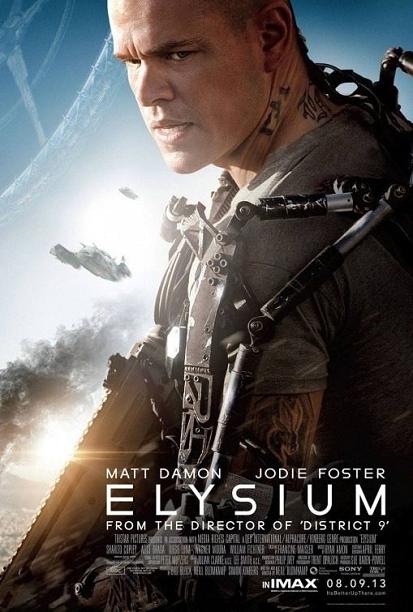
Feature: The Failure of 'Elysium'

by Todd Starkweather

The summer of 2013 has produced a large number of cinematic failures. I might have said that the summer of 2013 has produced an inordinate number of failures, but then I think back to all the previous summers of cinematic stinkers, and this summer's number of failures is probably ordinate. Indeed, most seasons produce large numbers of failures.  Summer’s (mostly financial) expectations, however, highlight and accentuate those failures.

Three weeks into its run, Neill Blomkamp's Elysium (2013) looks to be headed toward the "bust" or "bomb" category. Now, a box office bust or bomb does not always indicate a film's quality. Fritz Lang's epic and now near-universally revered Metropolis was, by the cruel logic of box office receipts, an epic bomb. Popular audiences have been known to ignore quality cinema, but Elysium's critical reception has, at best, been mixed. Even the more positive reviews, such as Anthony Lane's review in The New Yorker, take hundreds of words to dissect the more disappointing aspects of the film in an attempt to redeem its more positive features.

Part of the disappointment that Elysium has elicited seems to have stemmed from the expectations surrounding Blomkamp's second feature film. His first, District 9 (2009), was both a critical and financial success, garnering four Oscar nominations, including one for best picture. In both its script and direction, District 9 was a cleverly crafted sci-fi film with heavy doses of social criticism, yet the social criticism was added deftly enough so as not to spoil the film.

Similar to District 9, Elysium is a sci-fi action flick with heavy doses social criticism. Class struggle, lack of social mobility, unequal distribution of resources, healthcare, immigration, and countless other contentious issues worm their way into Blomkamp's second film. Unfortunately, the delicate mix of ingredients does not balance out, and the final product in Elysium tasted like an overcooked meal with too much seasoning.

The film's two distinct geographical locations, a dystopian, futuristic Los Angeles and the compass shaped space station/resort spa, Elysium, never effectively meld together. Los Angeles is essentially a slum, and Elysium is a high priced gated community. It is obvious that the workers in the slum sell their labor to the CEOs of Elysium for a small pittance, but Elysium fails to further analyze the dialectic situation it presents.

Elysium also fails to make Elysium attractive. While Blomkamp may have intended to create Elysium in the mold of the most boring, sterile gated community, he unfortunately created an environment that was a boring, sterile gated community. Aesthetically, the film suffers at any point when it moves to Elysium. The direction, editing, and camera work all seem weaker during the scenes on Elysium. And I cannot believe that I am about to admit this, but Jodie Foster's character, Delacourt, Elysium's director of defense, is rather boring and baseless. Any setting or location that makes Jodie Foster boring is a place that is most undesirable and probably should not exist.

By contrast, the scenes in the slum-ridden outskirts of Los Angeles are taught and visually compelling. Blomkamp and Elysium seem much more interested in Los Angeles, and, not unsurprisingly, the portions of the action that take place in Los Angeles are far more interesting. Elysium would have been a better film and script without Elysium.

Yet even if Elysium becomes a failure by whatever critical or financial standards apply to cinematic failures, such a failure is not always a bad thing. Many failures often lead to great things. I often tell my students that they need to fail in their initial readings and writings before they can become better. The above referenced Metropolis failed during its initial release and languished for years. But I doubt that Metropolis's fate will be the fate of Elysium. If Elysium is eventually regarded as a monument of cinematic achievement in the next hundred years, then that world will be far more horrifying than the one portrayed in Elysium.

I think (or hope) that a more accurate counterpart for cinematic failure would be Sam Peckinpah's Major Dundee (1965). Prior to Major Dundee, Peckinpah had created two smaller-scale Westerns: The Deadly Companions (1961) and Ride the High Country (1962). Similar to Blomkamp's District 9, Peckinpah's first two critically acclaimed films allowed him access to a bigger Hollywood budget and bigger Hollywood stars. And while Peckinpah would go on to work with big stars and big budgets in later projects, this first foray did not go well. And just like Elysium seems inconsistent with Blomkamp's previously displayed talents, Major Dundee fails to exhibit Peckinpah's exceptional directorial qualities. The film's lead, Charlton Heston, seemed to be an awkward fit for someone like Peckinpah. (Of course, Heston seemed to be an awkward fit in many films.) Similarly, Foster and Blomkamp seem ill matched. Both Blomkamp and Peckinpah were given shiny new toys, and in their initial excitement, they created their own fantastic messes.

Hopefully, Blomkamp can learn from his latest mess the same way that Peckinpah did from his. Peckinpah followed up Major Dundee with The Wild Bunch (1969). If Blomkamp comes anywhere close to approximating Peckinpah's success, then Elysium's failures will be much more palatable.

Friday, August 23, 2013

Ed. Note: VCU's Fall Line Fest


Ed. Note: Copy and illustration from VCU News:
Virginia Commonwealth University’s Institute for Contemporary Art presents a limited run of the four-channel video “Synaptic Bliss” by Aziz + Cucher during the Richmond Fall Line Fest Sept. 6-7 with an artist talk that is open to the public on Friday, Sept. 6.

The viewing takes place on the future site of the ICA at the corner of Broad and Belvidere streets, where four screens set within Portable On Demand Storage cubes will simultaneously play “Synaptic Bliss.”
Click here to read the whole story at VCU News, as written by Carrie Culpepper.


Short Subject: The Dove (De Düva)


Ed. Note: This 1968 parody of Ingmar Bergman's films offers the viewer a look at Madeline Kahn before she became a well known actress. Directed by George Coe, it also offers a few grins. For more information go here and here.

Thursday, August 22, 2013

Five Film Favorites: Movies About Making Movies

by F.T. Rea

Filmmakers tell us stories. 

The people who write the screenplays and direct the movies we see on screens, large and small, sometimes appear to know a lot about life in the old West, or modern teenagers in love, or lathered up serial killers, or witty social commentary, or whatever. However, what most successful filmmakers actually do know about, firsthand and in-depth, is what goes on behind the camera in the business of producing feature length motion pictures. 

Consequently, plenty of movies about making movies have been made; some of those inside looks at filmmaking are among the best features ever produced. After all, there’s no business like show business!

Which means narrowing the list down to just five titles this week wasn’t easy, but that’s my job.

Yes, “Sullivan’s Travels” (1941) is still a cool flick and it’s sort of about making movies. Yes, I always enjoy watching “Singin' in the Rain” (1952), even though most of the old studio system musicals from the 1940s and ’50s aren’t likely to ever appear on any favorites list of mine. Yes, “Wag the Dog” (1997) deserves more praise than it has received. And, most recently, I enjoyed “The Artist” (2011) quite a bit, although I‘ve only seen it once. Yes, more films could be cited in this paragraph, but today none of them have made the cut. 

This Thursday my five favorite movies about making movies are: 
  • “8½” (1963): B&W. 138 minutes. Directed by Federico Fellini. Cast: Marcello Mastroianni, Claudia Cardinale, Anouk Aimée. Note: While this is a film about making a film, don’t stew over trying to make sense of it. Just watch as Fellini dazzles you with unforgettable characters and images, as he shrugs and admits to his own confusion.
  • “Day for Night” (1973): Color. 115 minutes. Directed by François Truffaut. Cast: Jacqueline Bisset, Valentina Cortese, François Truffaut. Note: An engaging look at the process of crafting a movie's plot, with the soap-opera-like private lives of the cast and crew intermingling with the production. It could be seen as a director’s bittersweet confession.
  • “The Day of the Locust” (1975): Color. 144 minutes. Directed by John Schlesinger. Cast: Donald Sutherland, Karen Black, William Atherton, Burgess Meredith. Note: This foreboding story was adapted from the Nathanael West  novel about the fresh lure of stardom in Hollywood and the same old road to hell.
  • “The Player” (1992): Color. 124 minutes. Directed by Robert Altman. Cast: Tim Robbins, Greta Scacchi, Fred Ward. Note: Dealing out some payback to Hollywood, Altman pulls back the curtain to show us the blackmailing, back-stabbing side of how stories -- reduced to pitches -- get processed into movies. No doubt, Altman and his accomplices had fun making this one.
  • “Sunset Blvd.” (1950): B&W. 110 minutes. Directed by Billy Wilder. Cast: William Holden, Gloria Swanson, Erich von Stroheim. Note: For a young struggling writer, down on his luck, why not coast for a while? Why not facilitate the batty fantasies of a rich, has-been movie star? What could go wrong?
Yes, there’s a thread of cynicism that runs through all five of them. Perhaps that’s because the filmmakers felt compelled to remind the viewer that show business people just make stuff up all the time. We viewers shouldn’t really believe they know all that much about cowboys or modern teenagers.

No, we movie-lovers should just enjoy the best of these filmmakers’ efforts and take them for what they are, for the most part -- made-up stories, designed to tell us a larger truth about their ways/our ways.


Wednesday, August 21, 2013

Ed. Note: Film Lists


Ed. Note: David Lynch mentions some of his favorites movies and filmmakers in this short video.


Friday, August 16, 2013

Short Subject: 'Junkopia'


Ed. Note: “Junkopia” was shot in 1981 at the Emeryville Mudflats outside of San Francisco. The filming was done while director Chris Marker was also shooting footage in the area for his film, “Sans Soleil” (1983).

For more information click here and here.

Short Subject: The Power of Image

by James Parrish

I first met Steve Apkon at the Sundance Institute's Art House Convergence, an annual gathering of independent art house theaters that takes place in Midway, Utah, the week before the Sundance Film Festival each January. Steve is the executive director of the Jacob Burns Film Center, a nonprofit cultural arts center dedicated to presenting the best of independent, documentary, and world cinema; promoting 21st century literacy; and making film a vibrant part of the community. I've attended the Art House Convergence twice, in 2012 and 2013, as part of my research on establishing the Bijou Film Center.

Enjoy this great short film, I Am Here, made to accompany Steve's new book -- The Age of the Image. This little film shows exactly how image sound and story can be more effective than words alone. 


Connecting with leaders in the independent art house and independent media community like Steve is one of the best parts of the Art House Convergence. Before long and with your help, I'm convinced we can establish the Bijou Film Center to do for Richmond, VA what the Jacob Burns Film Center is doing for Pleasantville, NY.

In his book The Age of the Image (with a foreword by Martin Scorsese) Steve argues that it is time we understand why and how visual images are today's most powerful form of communication.
We are story animals. And we need to tell our stories in as direct, as
unmediated, and as emotionally resonant a way as possible.
-- Stephen Apkon, from The Age of the Image*
* Published by Farrar, Straus and Giroux. For more information, visit: theageoftheimage.com


Thursday, August 15, 2013

Five Film Favorites: Gems on YouTube

by F.T. Rea

Of course I’d rather watch a brand new print of any movie than an old beat up print. Likewise, given the choice, I’d rather see that pristine print projected onto a large screen than watch it on a laptop. But if the choice is between seeing or not seeing a film, let’s say it’s a Fritz Lang picture I’ve read about but never seen, the laptop will do.

Enter YouTube.

Over the last few months I’ve watched a bunch of old movies on YouTube at no charge. Sometimes the look of the movie has been better than others. On any given day, it seems thousands of titles are available. Some of the films are in the public domain, others may not be. Consequently, due to rights issues, they might not be available on YouTube for long.

Several of the gems I’ve watched recently have subsequently been pulled, so don’t wait to see one on the list below you really want to see. The opportunity might be gone the next day. 

In particular, I’ve been enjoying the black and white movies from the 1950s and early-‘60s. Of the movies in that category I’ve watched recently on YouTube, my favorite five today (with links that still work at this posting) are as follows:

  • “The Big Heat” (1953): B&W. 90 minutes. Directed by Fritz Lang. Cast: Glenn Ford, Gloria Grahame, Lee Marvin. Note: Ford is the cop who won’t be scared off of investigating the death of a colleague. Grahame is the gangster’s moll who gets caught in the middle. Marvin is the second-in-command of a crime syndicate; he routinely terrorizes people, especially women, for his own amusement. Click here to watch it.
  • “The Hitch-Hiker” (1952): B&W. 71 minutes. Directed by Ida Lupino. Cast: Edmund O’Brien, Frank Lovejoy, William Talman. Note: Based on a true crime spree story that had been covered extensively by the press in 1950. For a woman to direct a lean and brutal movie like this one was a breakthrough in that time. Talman’s quirky portrayal as the psychotic murderer is memorable. Click here to watch it.
  • “Paris Blues” (1961): B&W. 98 minutes. Directed by Martin Ritt. Cast: Paul Newman, Joanne Woodward, Sidney Poitier, Louis Armstrong, Diahann Carroll. Note: Nice soundtrack and just seeing the good looking stars of this story about Americans involved with the jazz scene in Paris is worth investing 98 minutes. These expatriates were way too cool for the processed rhythm and blues, folk music, etc., that was dominating the pop charts in the USA. Click here to watch it.
  • “Patterns” (1956): B&W. 83 minutes. Directed by Fielder Cook. Cast: Van Heflin, Everett Sloane, Ed Begley. Note: Written by Rod Serling, “Patterns” was first presented on the Kraft Television Theatre in 1955. A year later it was reworked as a feature film. Perhaps the most amazing thing about this story of dog-eat-dog immorality in the business world is how well it holds up -- Serling's dialogue is still crisp. Click here to watch it.
  • "Shake Hands With the Devil" (1959): B&W. 111 minutes. Directed by Michael Anderson. Cast: James Cagney, Don Murray, Dana Wynter, Richard Harris. Note: This story about an American medical student (of Irish heritage) getting inadvertently involved with revolutionary politics is set in Dublin in 1921. The student, who is also an apolitical WWI veteran, gets dragged into the IRA’s bitter battle with the thuggish Black and Tans. Click here to watch it. 


Pub. Note: 'The Harder They Come' 40th Anniversary Re-release

by James Parrish


After I tweeted Bijou Backlight editor Terry Rea's story about his work planning and executing a successful premiere screening of The Harder They Come at the Biograph Theatre some 40 years ago, lo and behold, we got "favorited" by the folks handling the 40th anniversary re-release of the film at select theaters on September 5th.

I love happy coincidences.

One of those theaters is Nashville's Belcourt Theatre, an anchor organization with the Art House Convergence, an annual gathering of this country's independent art house theaters. It's times like these when I wish the Bijou Film Center was already open -- I sure would love to have a hand in bringing the film back to Richmond ... 40 years later!

For now, this trailer and some wishful thinking will have to do.


Wednesday, August 14, 2013

Feature: Screening 'The Harder They Come'

by F.T Rea

Ed. Note: What follows is an episode of Biograph Times, which is a work-in-progress that hopes to one day become a book. Part memoir, part pop culture history, part folderol, the stories revolve around the Biograph Theatre (1972-87), as seen through the eyes of its original manager. The Biograph was an independent repertory cinema, located at 814 West Grace Street in Richmond, Virginia. It opened in an era that seemed ready to give the baby boomers, who were becoming adults, whatever they wanted. 


*

Still of Jimmy Cliff as Ivan.
In the fall of 1973, David Levy, then the most active managing partner/owner of the Biograph Theatres in Georgetown and Richmond, asked me to look at a film to evaluate its potential. From time to time he did that for various reasons. In this case he had a new 35mm print of “The Harder They Come” shipped to me. I managed the Biograph in Richmond.

In those days we had frequent after-hours screenings of films we came by, one way or another. Usually on short notice, the word would go out that we would be watching a movie at a certain time. These gatherings were essentially impromptu movie parties. A couple of times it was 1940s and '50s 16mm boxing films from a private collection.

Sometimes prints of films that were in town to play at another venue, say a film society, would mysteriously appear in our booth. In such cases the borrowed flicks were always returned before they were missed ... so I was told.

Although I don’t remember any moments, in particular, from that first screening of “The Harder They Come,” I do recall the gist of my telephone conversation with Levy the next day. After telling him how much I liked the Jamaican movie, he asked me how I would promote it.

Well, I was ready for that question. I had smoked it over thoroughly with a few friends during and after the screening. So, I told David we ought to have a free, open-to-the-public, sneak preview of the movie. Most importantly, we should use radio exclusively to promote the screening. Because of the success of the radio campaigns for the Biograph's midnight shows, over the last year, he liked the idea right away.

In this time, long before the era of giant corporations owning hundreds of stations, a locally-programmed daytime radio station with a weak signal played a significant role in what success was enjoyed at the Biograph. For a while we had a sweet deal -- a dollar-a-holler -- with WGOE-AM, the most popular station for the under-35 set in the Fan District and environs. In the first half of the 1970s, the station at the top of the dial, 1590, owned the hippie market. 

Subsequently, on a Friday morning in November the deejays at WGOE began reading announcements of a free showing of “The Harder They Come” that would take place at the Biograph that afternoon at 3 p.m. Then they would play a cut by Jimmy Cliff, the film’s star, from the soundtrack. This pattern was continued maybe three times an hour, leading up to the time of the screening.

*

“The Harder They Come” (1972): 120 minutes. Color. Directed by Perry Henzell; Cast: Jimmy Cliff, Janet Bartley, Carl Bradshaw. In this Jamaican production, Cliff plays Ivan, a pop star/criminal on the lam. The music of Cliff, The Maytals, The Melodians and Desmond Dekker is featured.

*

Of course, Reggae music was being heard in Richmond before our free screening, but it was still on the periphery of popular culture. As I recall, some 300 people showed up for the screening and the movie was extremely well received.

In previous runs in other markets, “The Harder They Come” had been treated more or less as an underground movie. As it was shot in 16mm and blown up to 35mm for its American distribution, it had a grainy, documentary look to it that added to its allure. Upon hearing about the audience's approval, Levy got excited and wanted to book it to run as a regular feature, rather than as a midnight show.

While it didn’t set any records for attendance, “The Harder They Come” did fairly well and returned to play several more dates at the Biograph, at regular hours and as a midnight show. 

Levy became a sub-distributor for “The Harder They Come.” When he rented it to theaters in other cities within his region, he urged them to use the same radio-promoted, free-screening tactic.

Over the next few years Reggae music smoothly crossed over from niche to mainstream to ubiquitous. Bob Marley (1945-81), dead for over 30 years, still has a huge following to this day. Reggae's acceptance opened the door for the popularity of the still-fresh fusion sound of the 2 Tone bands, like The Selecter, The Specials, the (English) Beat, Madness, and so forth, in the early-1980s.

Looking back on it, watching a mostly-unknown, low-budget Jamaican film with that impromptu after-hours crowd was about as cool as it got in those days ... at least in the Fan District. 

*

Ed. Note: Click here to read more of the completed episodes of Biograph Times. 


Bijou Diaries: It Begins with a Kid

by James Parrish

Charles Starrett as The Durango Kid
Ed. Note: This begins what will be a series of posts written by the publisher of the Bijou Backlight.

*

The idea for the Bijou Film Center really begins with a kid -- the Durango Kid. You see, I grew up listening to my dad to tell stories of the many Saturdays he spent at the Princess Theatre in the 1940s and 50s in Benson, North Carolina, our hometown.

By the time I came along, the screen of the Princess had long been dark and those exciting Saturdays packed with enthusiastic kids were trapped behind the boarded up windows and doors of the theatre, projected only the mind's eyes of those kids, now adults, like my dad and his childhood friend, "Fish."

Even today, you can see the twinkle in his eye when he describes how he gathered his pennies and nickels for the Saturday afternoon shows by selling discarded soft drink bottles to the grocer, old newspapers to the fish market and used coat hangers to the dry cleaners. For dad those pennies and nickels were passage into the worlds of Wild Bill Hickcok, Lash LaRue, Whip Wilson, Johnny Mack Brown, Bob Steele, Gene Autry, Roy Rogers, and his favorite, the Durango Kid. When the credits rolled, my dad and his friends would fling open the doors of the Princess, rushing home to recreate this week's showdowns between good and evil.

It was my dad who took my brother and me to the movies to see Star Wars and Indiana Jones and countless others, giving us our own childhood memories and passing along his love of the movies. The Bijou Film Center, first and foremost, will be for the kid in all of us who wants nothing more than to spend Saturdays at the movies and then save the day, just in the nick of time.

Tuesday, August 13, 2013

Short Subject: 'The Film That Warped Too Much'


by F.T. Rea

Once its doors open for business, in addition to presenting lots of movies, the Bijou Film Center will start doing what it can to become a part of the overall effort to preserve old films and convert them to modern formats; the emphasis will be on Super 8 and 16mm films.

The Bijou, a little cinema with a single auditorium, will be the heart of the nonprofit Bijou Film Center, which will be established in the Richmond's burgeoning Arts District. However, the new Bijou will be more than just a movie house.

The ongoing development of film restoration technology is fascinating. New techniques are putting the magic back into fragile old footage. For a glance at how some of that is being done, click play on the Criterion Collection's YouTube video above, to watch “The Film That Warped Too Much.”

Thursday, August 8, 2013

Five Film Favorites: Westerns Set in the 20th Century

by Todd Starkweather

Last week Terry Rea kicked off the Bijou Backlight with a five film favorites article which listed his five favorite Westerns. Terry’s list spanned from Stagecoach (1939) to Unforgiven (1992) and contained films from the ’40s, ’50s, and ’60s. His list demonstrated the longevity and malleability of my most favorite film genre. Since I too love Westerns, I decided to piggyback on Terry’s list and produce a more narrow list of Westerns: Westerns set in the twentieth century.
The conventional notion of the Western is one of a film that is situated somewhere in the American West of the 19th Century (usually after the Civil War); however, the West as a concept and theory that shapes American attitudes and notions of self and nation did not stop existing once the clock struck midnight on January 1, 1900, nor did it stop with the influx of the automobile, the interstate highway system, or the urbanization and suburbanization of post-WWII America.

When John Ford was making Westerns in the ’30s, ’40s, and ’50s, the American West of the previous century was only a couple of generations removed, and some of the men and women who lived that history could have actually purchased a ticket to see a Ford film. The history was more relevant and immediate, and the Westerns of ’40s and ’50s must have seemed more tactile to the audiences then than they do to us now.

The more interesting, thoughtful, and provocative Westerns of the past few years have attempted to make sense of a more recent 20th Century history of the West. Contemporary Westerns that are set in a more distant past, no matter how slick and accurate, have the feel of hollow simulacra. I would point to the remake of 3:10 to Yuma (2007) and Appaloosa (2008) as examples of this. These films are not necessarily “bad,” but they do not capture the power and relevancy of the history. Instead, they attempt to capture that which originally captured the history.

After compiling my list, I retroactively noticed that it is quite contemporary, with four of the five films having been produced and released within the last eight years. I did limit myself to only one Peckinpah film. Junior Bonner (1972) and The Ballad of Cable Hogue (1970) could have made their way into the list, but I wanted more directorial variety. I also decided not to re-use any of the Westerns that Terry listed among his favorites. The Treasure of the Sierra Madre (1948) and Lonely are the Brave (1962) could have easily displaced one or more of the films on my list, but I wanted to provide new names. Such decisions obviously influenced how heavily tilted the list is toward films made in the last decade, but we all need parameters. 
Without further ado, my five favorite Westerns set in the twentieth century:

The Wild Bunch (1969) – Directed by Sam Peckinpah

I am not going to write much more than this: I think that The Wild Bunch is quite possibly the greatest American film ever made.

Brokeback Mountain (2005) – Directed by Ang Lee

Brokeback Mountain is similar to The Wild Bunch in this one respect: it has aged well and will continue to age quite well. The film is no less powerful or amazing now than it was upon its release. Part of the obvious initial public resistance to it was that it had “gay cowboys” and was portrayed as a film about sexual orientation and gay rights. Yet it is much more properly viewed as a Western that examines how the changing landscape of rural America makes surviving and prospering within the traditional rural economies of agriculture and livestock difficult if not impossible. Ennis Del Mar (Heath Ledger’s second greatest performance), the rugged cowboy who can handle anything, is reduced to living in a trailer home because the West no longer needs actual cowboys. And Jack Twist (Jake Gyllenhaal), the man who literally faked being a cowboy (he worked as a rodeo clown), arrives at financial security by marrying into a family whose agri-business actively destroys the livelihoods of the cowboys like Ennis.

I would also point out that Brokeback Mountain‘s cinematography was splendid. Lee is a gifted visual director, and his gifts were put to great use here. The film made love to the land that it captured on film.

No Country for Old Men
(2007) – Directed by Ethan and Joel Coen

I am not certain that No Country will age as gracefully as Brokeback Mountain, and even as I put it on my list, I am less disposed to it now than I was when it came out in 2007. Three things, though, still prompt me to include it in this list: a) the thematic influences of Peckinpah’s West as a vanishing territory that no longer has any room for the men and women who once prospered in it; b) Josh Brolin’s performance as a square-jawed man who must ultimately fail but is still worthy of admiration and respect due to his grit and resourcefulness; and c) Roger Deakins‘s cinematography. Being able to artistically fit a vast Western landscape into the camera is, at least for me, a crucial element of the genre.

There Will Be Blood (2007) – Directed by Paul Thomas Anderson

Released the same year as No Country, I had originally privileged the Coen’s film as the superior one. I have since reversed course. Anderson’s direction is just about perfect from a technical standpoint. There Will Be Blood is a little tough to digest at first because there is only one character who matters, Daniel Day-Lewis‘s astounding Daniel Plainview, and the plot is essentially nothing more than the creation of capital and wealth.

Williams Cronon’s book Nature’s Metropolis: Chicago and the Making of the Great West essentially posits that the West was created by turning first nature into second nature and then creating commodities for the market. There Will Be Blood is a perfect artistic rendering of Cronon’s well thought out materialist history of the American West.

The Good, the Bad, the Weird (2008) – Directed by Ji-woon Kim

This film is a blast. Set in 1930s Manchuria, this Korean re-imagining of The Good, The Bad, and the Ugly obviously takes a lot from Asian cinematic influences: South Korea and Hong Kong most notably. But it is still a Western; the use of rail and horses signal a debt to the traditional American Western. Despite its occasional preposterousness, it does a rather deft job of commenting upon imperial, colonial, and post-colonial histories in East Asia. For those of you who require more endorsements, The Good, the Bad, the Weird was also one of Peter Schilling’s honorable mentions for best 10 films of 2010. (Special thanks to James Parrish for recommending this film to me.)

Wednesday, August 7, 2013

Ed. Note: Film Lists

Lists are fun. Open Culture has recently published three lists of the favorite films of luminaries:

Stanley Kubrick   
More?

OK, here’s Roger Corman’s Top Ten at the Criterion Collection’s web site. And, you can find a bunch of other Top Tens on this web site if click on the Top 10s link there.

You say Favorite Fives or Top Tens don’t embrace the concept as thoroughly as you‘d like to see it done? Too easy? Can’t get enough of this?

Here’s the Criterion Collection’s link to Roger Ebert’s Great Movies. There are 141 titles on the list.

Every Thursday the Bijou Backlight will publish another exclusive Five Film Favorites column. Submissions are welcomed.
-- Photo from Open Culture.